
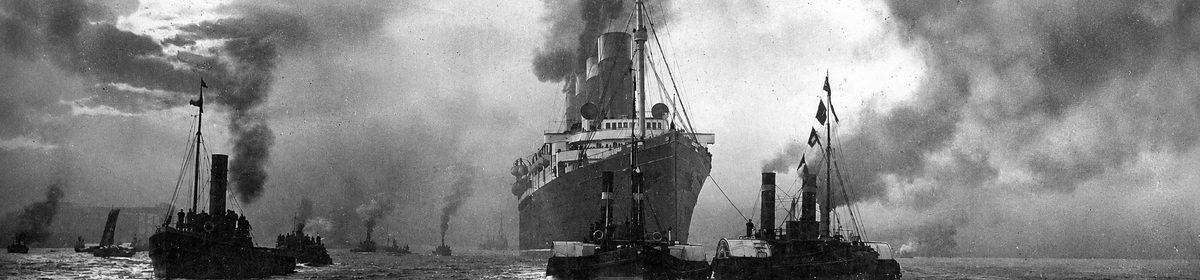

If I could snap my fingers and have any ship alive and well today? The RMS Olympic would be it! There was a reason my first real post was The Three Sisters. The ship survived and served passengers and the WWI effort for 24 years.
Before the Titanic’s maiden voyage, it was actually the RMS Olympic that was White Star Line’s best-known and most celebrated liner. She had already established her reputation with passengers and the public. Only after the Titanic disaster did history forever shift the spotlight to her younger sister. While Titanic became the legend, Olympic became the ship that proved the design could succeed.
I’ve grown to love this ship even more than her almost twin younger sister, Titanic. Olympic never sank. She survived World War I and returned to passenger service afterward, sailing for nearly twenty-four years. In many ways, she became everything the Olympic-class ships were meant to be. She carried thousands of American and Canadian troops during the war and quietly earned the nickname “Old Reliable.” The press had called Titanic “unsinkable,” but Olympic was the ship that truly lived up to that reputation.
She didn’t become famous because she sank. She became famous because she didn’t. To me, she is the most beautiful ocean liner ever built. She isn’t flashy. She is simply regal and timeless. Others like the SS Normandie and the SS United States were beautiful, but Olympic’s outward appearance was hard to beat.
The White Star Line built the RMS Olympic because they were locked in a battle with the Cunard Line in the early 1900s. Cunard had shocked the shipping world with the fast and luxurious RMS Lusitania and RMS Mauretania. Those ships held the speed records of the Atlantic and became symbols of British pride. White Star knew they could not win by building the fastest ships. They would create huge liners built around comfort, size, and luxury instead of outright speed. That idea became the Olympic-class ships, Olympic, Titanic, and later Britannic.
When Olympic entered service in 1911, people were stunned by her size. She had grand staircases, elevators, electric lights, Turkish baths, a swimming pool, a gymnasium, and first-class rooms that looked more like expensive hotels. Even second-class accommodations were considered better than first-class on many older ships. White Star advertised her as a steady and comfortable ship for wealthy travelers and immigrants alike. She was not designed to break speed records. She was designed to make passengers feel safe and relaxed crossing the Atlantic. That was her selling point. While Lusitania and Mauretania were faster, they were also known for rolling in rough seas. Olympic was built for comfort, and passengers appreciated the smoother ride. She had quite a few captains in her career. Captain Edward John Smith was the first captain and later would go to captain the Titanic.
After the loss of the RMS Titanic in 1912, Olympic suddenly carried a heavy burden. Many people feared that the Olympic-class ships were cursed or unsafe. But Olympic slowly rebuilt public confidence. She returned to service with major safety improvements, including more lifeboats and a strengthened double hull. She then became a war hero. Olympic was converted into a troopship during World War I. If you’d like to learn how passenger liners were transformed for military service, see our companion page: From Luxury to War: How Ocean Liners Became Troopships.
During World War I, she served as a troopship and carried thousands of soldiers across dangerous waters. In 1914, she spotted HMS Audacious, a battleship that was sinking. She stopped and risked being hit by a U-boat to rescue over 200 sailors. For a more complete story, go to the companion page. She even rammed and sank a German U-boat in 1918, something almost unheard of for a passenger liner. A reconstructed animation of this event is at the bottom of the page. She was also dressed up in her Dazzle Paint (She looked like a sixties rock band logo).

She kept sailing while many famous ships disappeared through war, accidents, or financial trouble. Passengers trusted her. Crews respected her. She crossed the Atlantic hundreds of times and carried everyone from immigrants to celebrities. In many ways, Olympic became the ship White Star had hoped for from the beginning: dependable, elegant, and respected. She even became something of a movie star, appearing in several films that can still be seen today. Among her passengers were Charlie Chaplin, Mary Pickford, Douglas Fairbanks, Prince Edward, Cary Grant, Marie Curie, and many others. The Olympic ended up completing 257 round trips across the Atlantic (not counting the war) and traveled over 1.8 million miles.
On November 18, 1929, while crossing the North Atlantic near the resting place of her sister, the Titanic, Olympic experienced an unusual vibration that ran through the entire ship. At the time, no one knew why. The answer came later: she had been near one of the largest undersea earthquakes ever recorded in the North Atlantic. It was a strange coincidence that forever linked the two sisters once again, not through tragedy this time, but through one of nature’s most powerful events.
Among Olympic’s crew was stewardess Violet Jessop, who was aboard during the 1911 collision with HMS Hawke. She later survived the sinking of Titanic as a stewardess and Britannic as a wartime nurse. Depending on how you look at it, Jessop was either the unluckiest woman ever to work at sea, or the luckiest.
By the mid-1930s, Olympic was still a wonderful ship, but the world around her had changed. The Great Depression hurt the shipping business badly. Fewer people could afford ocean travel. Newer ships were also coming along that were faster and more modern. White Star Line was struggling for money and merged with Cunard in 1934. Olympic was already over 20 years old by then. Even though she was still running well, she cost a lot to operate and still had steam engines. In the end, the company decided to scrap her in 1935. It shocked many people because she had survived collisions, wartime service, bad storms, and decades at sea. To many, she still seemed full of life. Even in retirement, Olympic continued to serve. Her dismantling at Thomas W. Ward’s scrapyard in Jarrow provided nearly two years of employment during the depths of the Great Depression.
It’s easy to imagine what might have been. Had Olympic been preserved like the Queen Mary, millions of people could have walked her decks and experienced the closest thing to sailing on the Titanic. But forget the Titanic; it’s the friggin Olympic! But those were the years of the Great Depression, and preserving a ship wasn’t a realistic option. You cannot look at things like that with presentism. Even so, Olympic still lives on. Parts of her survive today! She is in the White Swan Hotel, where her beautiful wood paneling, windows, and fixtures continue to be admired. In a small way, the ship still welcomes guests and is not a museum piece. Parts of her are still working after over 100 years.
If I could travel back in time and sail on any ocean liner, Olympic would be my choice. Others were faster. Some were even more luxurious. But I would choose the ship that quietly did her job for nearly a quarter of a century and earned the nickname Old Reliable. I can’t think of a finer legacy than that.


Olympic wearing her World War I DAZZLE paint camouflage. The bold geometric patterns weren’t meant to hide the ship. They were designed to make it more difficult for German U-boat commanders to judge her speed, course, and heading through a submarine periscope.
A 30-minute short documentary of Olympic


