
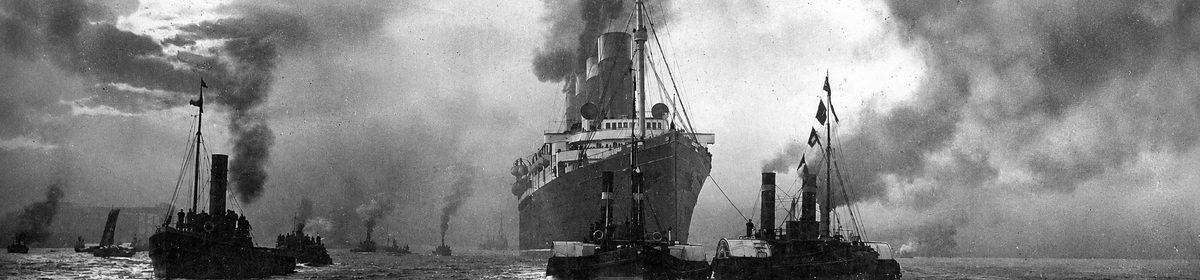

This may be the most elegant and well-designed ocean liner ever built. People could walk around her and simply stare. For me, not counting the Edwardian era (Olympic, Mauretania, etc.), the Normandie, SS United States, and Île de France are probably my favorite liners from the 1920s onward. I would still pick the Olympic for my tastes, but the consensus among “ship people” is that this ship had everything, and it’s hard not to agree. The French had some of the most beautiful ships.
I hope you don’t mind a lot of pictures. She deserves them.
The SS Normandie was France’s answer to the great ocean liners of the 1930s. She was launched in 1932 and entered service with the French Line in 1935. Four years before she began sailing, the SS L’Atlantique (more on her later) had already offered passengers a glimpse of the Art Deco future. The Normandie took those ideas and built an entire ship around them.
At 1,029 feet long, she was the first ocean liner to exceed 1,000 feet. Her hull was designed by Vladimir Yourkevitch, a Russian-born naval architect whose unusual bow helped the enormous ship move through the water efficiently. Her steam turbines did not turn the propeller shafts directly. Instead, they powered generators that supplied electricity to four enormous motors, one for each propeller.
She was more than a beautiful ship. She was one of the most technologically advanced liners of her time.
Her interiors were the part that people remembered. The first-class dining room was 305 feet long, rose three decks high, and was longer than the Hall of Mirrors at Versailles. Lalique glass, bronze, sculptures, murals, and carefully designed lighting turned the ship into a floating exhibition of French art. She also had a theatre, winter garden, chapel, indoor swimming pool, and first-class apartments with private dining rooms and terraces.
A ship this elaborate depended on more than architects and decorators. More than 1,300 crew members kept her operating. The French Line expected the ship to represent the best of France on every crossing. That meant French food, polished service, spotless public rooms, and an experience intended to rival the finest hotels in Paris.
The Normandie made her maiden voyage from Le Havre to New York in May 1935. She crossed in a little more than four days at an average speed just under 30 knots, taking the Blue Riband from the Italian liner Rex. She also broke the eastbound record on her return voyage.
There were problems. Passengers noticed serious vibration near the stern when the ship traveled at high speed. During a refit, her original three-bladed propellers were replaced with four-bladed ones, greatly reducing the vibration. The refit also increased her measured tonnage, allowing France to continue calling her the largest liner in the world after Britain’s Queen Mary entered service.
The rivalry between the two ships became one of the greatest in ocean-liner history. The Queen Mary took the speed record in 1936. The Normandie reclaimed it in 1937, only for the British ship to win it again the following year.
The French ship may have been the more beautiful of the two, but the Queen Mary proved more practical and commercially successful. The Normandie devoted an enormous amount of space to first class and was expensive to operate during the Great Depression. She was famous around the world, but fame did not always fill her cabins.
During her short career, Normandie carried some of the most famous people of the era. Ernest Hemingway, Fred Astaire, James Stewart, Marlene Dietrich, Walt Disney and the real von Trapp family all crossed the Atlantic aboard her. Disney sailed on her in 1935, while James Stewart was aboard her final peacetime crossing in August 1939. For a ship that spent only four years in regular service, she accumulated an extraordinary passenger list.
When World War II began in September 1939, the Normandie was safely tied to Pier 88 in New York. She had arrived on August 28 and would never sail again.
For a short period in 1940, the Normandie, Queen Mary, and the new Queen Elizabeth were docked beside one another in New York. The three largest liners in the world sat together while Europe descended into war. The two British ships eventually departed and became troopships. The Normandie remained behind.
After the United States entered the war, the government took possession of her. The Navy renamed her Lafayette and classified her as the transport AP-53, although she was never commissioned. Workers began converting the former luxury liner into a troopship like the other two.
On February 9, 1942, sparks from a cutting torch ignited a pile of kapok-filled life preservers inside a former first-class public room. The fire spread quickly. The ship’s original firefighting system had been disrupted during the conversion, and some American fire hoses could not connect to her French fittings.
Fireboats and crews on the pier poured thousands of tons of water into the ship. By evening, the flames were largely under control, but the water was not distributed evenly. The Lafayette developed an increasing list to port.
Vladimir Yourkevitch came to the pier and offered his knowledge of the ship, but he was not placed in control of the effort. During the early hours of February 10, the great liner slowly rolled onto her side in the mud beside Pier 88.
One man died. Frank “Trent” Trentacosta, a 36-year-old member of the fire watch, was killed, while hundreds of workers, sailors, and firefighters required treatment for injuries, burns, smoke inhalation, or exposure.
Rumors of sabotage spread quickly, especially because the United States had entered the war only two months earlier. The official investigation found something less dramatic but just as damaging: careless work, divided authority, poor coordination, and no unified command aboard the ship. The Normandie had not been destroyed by one unavoidable event. She had been lost through a chain of preventable failures.
Salvage crews spent more than a year removing her damaged upper works and carefully righting the hull. By August 1943, she was upright and floating again. There were proposals to restore her or find another military use, but the cost was enormous and the war had moved on without her. She was sold for scrap in 1946.
William Francis Gibbs later designed the SS United States with an almost obsessive concern for fire protection. Combustible materials were kept to an absolute minimum. Gibbs had admired the Normandie, traveled aboard her, and examined her machinery. When his own great liner finally appeared, it combined speed and beauty with lessons the maritime world had learned the hard way.
The saddest part of the Normandie’s story is that passengers who sailed aboard her in 1938 and 1939 had no idea they were experiencing the end of an age. People dressed for dinner, danced to orchestras, and watched the Atlantic pass outside the windows. Within months, Europe was at war, and the glamorous world the ship represented had vanished.
I think what makes the Normandie different is that she never had one defining tragedy at sea. Instead, she represented the very best of an age that disappeared almost overnight. Her passengers enjoyed some of the final peaceful crossings before World War II. Her crew spent years making her one of the finest ships ever built. The people who watched her burn weren’t watching just another ship. They were watching the end of an era.
Sometimes history isn’t lost in the middle of the ocean. Sometimes it slips away while tied safely to the dock. This will not be the last French liner to have such a fire, and it wasn’t the first.


Home movies on the Normandie. Passengers playing deck tennis aboard Normandie. The popular liner game combined tennis with quoits, using a rubber ring thrown across a net.


